Jun 16, 2026
The global solar farm market is expanding at a remarkable pace—from $140.94 billion in 2025 to $168.19 billion in 2026, a compound annual growth rate of 19.3%. At the same time, agrivoltaics—the practice of combining solar energy generation with agricultural production on the same land—has crossed a $5.5 billion global market in 2026. For farmers, landowners, and investors, agricultural solar mounting systems represent not just an energy investment, but a strategic land-asset decision.
So how do you actually maximize ROI on farmland solar mounting systems in 2026? Here are the six key levers that separate profitable agrivoltaic projects from money-losing experiments.
1. Choose the Right Mounting System for Your Land
Not all farm solar panels are created equal. The mounting structure you choose determines what you can grow, what equipment you can use, and ultimately, your bottom line. Here are the main system types in commercial operation today:
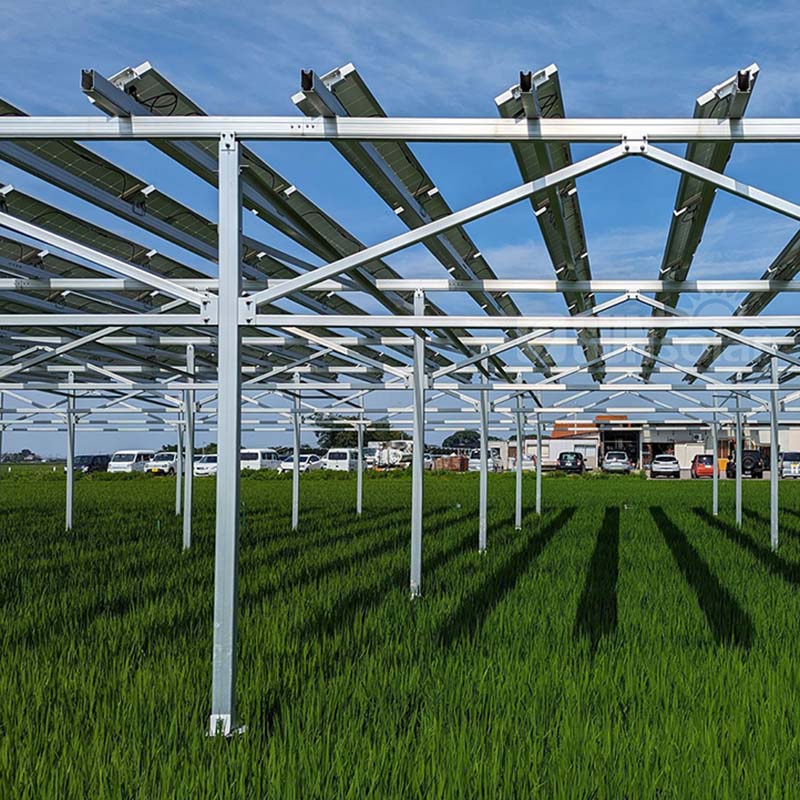
Elevated Agrivoltaic Systems (3–5 meters): Panels installed at heights that allow large farm machinery—combine harvesters, tractors—to operate underneath. Best for cereal crops, corn, and broad-acre farming.
Standard 2.1-Meter Rise Systems: The lowest-cost viable option that still allows tractor access and sheep grazing. In Germany's 15 MW Adorf project, cattle graze comfortably under panels mounted just over 2 meters high.
Vertical Bifacial Systems: Panels installed vertically, facing east-west, occupying only about 2% of the land area while leaving 98% available for agriculture. Ideal for orchards and pasture in high-insolation regions.
Ground-Level Agrivoltaics (1.1–1.5 meters): A newer, lower-cost approach using flexible block units rather than conventional rows. Structure costs run just €0.03–0.04/W—compared to €0.06/W for 2.1-meter systems and €0.09/W for 4-meter designs. Excellent for poultry and livestock operations where predator protection is a bonus.
Solar Greenhouses: Panels mounted on greenhouse roofs, with crops growing underneath. A 1 MW system can generate both electricity revenue and premium crop income from high-value produce.
The key decision point: Your choice depends entirely on what you grow, what machinery you use, and your local land-use regulations. Choose wrong, and you'll sacrifice either crop yield or energy output—or both.
2. Optimize Design Parameters: The Art of Light-Sharing
The core challenge of dual-use solar is light-sharing—balancing crop light requirements against energy production. Here are the critical design parameters:
Ground Coverage Ratio (GCR): Standard solar farms run at 0.5–0.6 GCR. Agrivoltaic systems need to drop to 0.2–0.3, with row spacing of 8–12 meters to leave room for crops and machinery. Yes, you sacrifice some capacity—but you keep your agricultural income stream.
Panel Height: According to Fraunhofer ISE research, 5-meter elevated agrivoltaic systems generate about 75% of the electricity per unit area compared to dense ground-mount systems. But higher panels mean more light transmission and better airflow for crops.
Bifacial Modules: Pairing bifacial solar panels with optimized racking captures reflected light from the ground below. Yield gains of 15–25% over monofacial panels are now common, and bifacial module costs have fallen 25–30% since 2024. Glass-glass modules also degrade at just 0.3–0.5% annually versus 0.7% for conventional panels—stretching your revenue horizon.
Tracking Systems: Single-axis trackers can increase energy production by 25–35% compared to fixed mounts. While tracking adds $0.15–$0.35 per watt to project costs (a 10–20% premium at utility scale), the revenue upside often justifies it. According to analysis by the Institute of Energy Economics at the University of Cologne, tracker systems achieved a 43% higher market value than fixed south-facing installations. Even better: tracker-based agrivoltaic systems allow 60–80% of land to remain in agricultural use.
3. Crunch the Numbers: Real Costs and Returns in 2026
Agricultural solar mounting systems cost more than standard ground-mount—but the returns are also higher.
Cost Breakdown
Installed costs for agrivoltaic systems run $1.50 to $2.33 per watt—20 to 50 percent above standard ground-mount. The premium comes from:
Elevated mounting structures (+15–25% capex versus ground-mount solar)
Wider row spacing (reduces panel density)
Foundations and engineering for agricultural compatibility
For a 1 MW agrivoltaic system, you're looking at roughly €40,000–60,000 per year in electricity revenue, plus whatever crop income you generate.
Revenue Streams—Diversify or Die
Electricity Sales: Power Purchase Agreements (PPAs) for projects commissioned in early 2026 currently range between €63 and €70/MWh. Feed-in tariffs in major markets provide guaranteed cash flows that offset the 15–20% capital premium.
Crop Income: Shade-tolerant crops—lettuce, berries, peppers, herbs—often maintain or even increase yield under partial shading, especially in hot climates where panels reduce heat stress and water evaporation.
Land Lease: If you're not operating the system yourself, land lease rates for agrivoltaic projects reach €800 to €2,500 per hectare per year in Europe and $700 to $1,400 per acre in the US. Solar developers typically sign 25- to 40-year leases at $1,000 to $3,000 per acre annually.
Sheep Grazing: The "solar sheep" model is proving highly profitable. Researchers at Western University found that optimized agrivoltaic sheep grazing models can reach an ROI of up to 43%. The animals graze under panels, saving feed costs and eliminating mechanical mowing.
Carbon Credits: Emerging carbon markets are beginning to recognize agrivoltaic projects for their dual emissions-reduction and land-preservation benefits.
Real-World ROI Examples
Germany: Diversified annual profits of €15,000–235,000 depending on farm scale
Malaysia (oyster mushroom cultivation) : Agrivoltaic systems delivered 42.13% higher annualized ROI and 13 months earlier payback compared to conventional PV plants
Ontario sheep grazing: Optimized auction models reached 43% ROI
General agrivoltaic: Land productivity increases by 60–70% compared to single-use agriculture or solar alone
The economics are clear: the dual revenue streams from crops and electricity now warrant a 15–25% capital premium over conventional solar.
4. Pick the Right Crops—Not All Plants Like Shade
Not every crop belongs under solar farm panels. Here's what the research shows:
High-Compatibility Crops (yield stable or improves):
Lettuce, berries, peppers, herbs, tomatoes
Shade-tolerant vegetables that benefit from reduced heat stress and water evaporation
Oyster mushrooms (42%+ ROI improvement documented)
Medium-Compatibility Crops (need elevated panels, low GCR):
Cereals and grains—yield drops unless panel density is below 0.20 GCR
Rice—a Jiangsu pilot showed only 3.2% yield drop, but electricity + brand premium lifted per-acre income 11%
High-Value Applications:
Tea plantations (PV-integrated tea fields being researched by USDA)
High-value berries and lettuce where tracker systems are already deployed
The principle: Don't design for "maximum power." Design for "maximum crop yield within acceptable power generation." In 2026, leading farms are moving toward spectrum-adapted crop portfolios—matching crop selection to the specific light transmission characteristics of their panels.
5. Leverage Policy Incentives—They're Worth Real Money
2026 is the year agrivoltaics policy goes mainstream. Solar farm incentives are proliferating globally:
Europe
Italy's Agrisolare: €1.5 billion allocated for farm solar
Germany's KfW: Below-market-rate loans for agricultural solar
France: Specific agrivoltaics legislation with a 450 MW cooperative project driven by 35 growers
UK Smart Export Guarantee: Export payments for farm-scale solar generation
Germany's DIN SPEC 91434: The first dedicated agrivoltaics standard
Asia-Pacific
Japan: 6,100+ agrivoltaic sites; 2040 renewables roadmap prioritizes agrivoltaic capacity
India's PM-KUSUM: Targets 10,000 MW of decentralized solar plants on agricultural land; a dedicated 10 GW agri-PV component is planned
China: 500+ commercial-scale projects integrating aquaculture, field crops, and livestock
North America
US: 600+ agrivoltaic projects documented by the National Lab InSPIRE team
Colorado: Agrivoltaics Research and Demonstration Grant program for FY 2026–27
Oregon: Agrivoltaics Task Force established to study solar siting on agricultural lands
New Jersey: Solar Renewable Energy Certificate program targeting 3,750 MW by 2026
Critical alert: The US House-passed farm bill contains provisions that would restrict USDA financial assistance for certain ground-mounted solar projects on agricultural land. However, the bill includes exceptions for projects converting less than 5 acres—or less than 50 acres if the majority of energy is used on-site. Know your local rules before you commit.
6. Avoid the Hidden Risks—What's in Your Contract?
The agrivoltaic sector is maturing, and 2026 is seeing a surge in disputes over operations and maintenance (O&M) responsibilities. Here are three clauses that belong in every contract:
① Performance Guarantees: If panel degradation exceeds 0.45% annually, the supplier compensates you for the lost energy—in cash.
② Structural Response: If mounting structures fail (e.g., a torn greenhouse film under panels), response within 2 hours, replacement within 48 hours.
③ System Downtime: If the smart control system goes down for more than 2 hours, the operator pays 200% of the daily crop value lost.
One Shandong project lost three pepper planting cycles because a contract lacked clause #2—a storm shredded greenhouse film and finger-pointing dragged on for months.
Conclusion: ROI in Agrivoltaics Is a Multiplier Game
Agricultural farmland solar mounting systems aren't just about "bolting panels to the ground." They're a land-asset upgrade. The global agrivoltaics market is projected to grow from $15.25 billion in 2026 to $56.83 billion by 2031—a 30.1% CAGR. Europe's 2026 is the "scale-up year," when agrivoltaics shifts decisively from isolated pilots to investment-ready infrastructure.
The farms that win in this space will be those that:
Choose the right mounting system for their specific crops and machinery
Optimize design parameters (height, GCR, tracking) for both crops and power
Diversify revenue (electricity + crops + grazing + carbon)
Pick crops that thrive under partial shade
Stack every incentive they qualify for
Write bulletproof contracts that protect against O&M disputes
One piece of land. Two income streams. Farming continues, power is generated, and the ROI multiplies.
Read More



 IPv6 network supported